
What’s Really Happening With Climate Finance?
It is well known that the actual supply of climate finance is well below the evident requirements, both for mitigation and adaptation. There is some talk of how the rich countries that promised $100 billion annually for the developing world to meet its climate change alleviation targets, finally managed to achieve and even cross that number in 2022. But since there is no clear definition of climate finance that is internationally accepted and the available estimates also depend on self-reporting by donor countries and multilateral institutions, even that relatively small sum is open to question.
However, despite the paucity of publicly provided funds and very inadequate resources provided by rich country governments, trends in climate finance have changed quite significantly
in the past few years, with newer sources of financing emerging, albeit with mixed effects. A recent report from the Climate Policy Initiative (The Global Landscape of Climate Finance 2025) shows that globally, total climate finance (in all countries, including public and private sources) increased to nearly $2 trillion by 2023.
Of this, mitigation finance made up the most significant chunk, estimated at $ 1.78 trillion in 2023. Adaptation finance was much lower at only $ 65 billion, although the report cautions that this could be an underestimate because of tracking challenges. Dual-benefit finance—pursuing both adaptation and mitigation objectives—reached $ 58 billion.
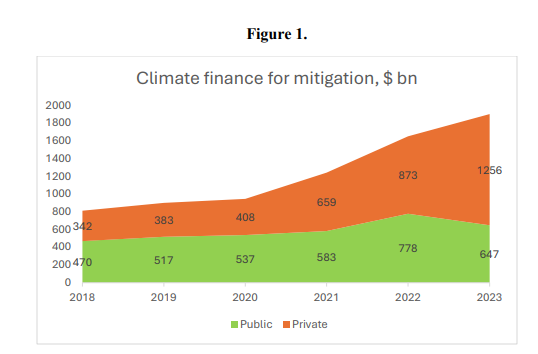
Figure 1 indicates that there was a significant increase in mitigation finance especially since 2021—and that this was mainly private sector-led, as publicly provided finance actually fell slightly between 2022 and 2023. Private climate finance contributions crossed $ 1 trillion for the first time in 2023, increasing by more than 50% compared to 2022. What is particularly of note is that within this, households were the largest private contributors, rather than corporations. Households—most of all in North America and Europe—invested in electric vehicles, solar water heaters, and renewable-energy-powered HVAC systems in response to rising energy costs. Such responses were also evident, albeit on a much smaller scale, in lower income countries like Pakistan.
Source for all figures and table: Calculated from Global Landscape of Climate Finance 2025, Climate Policy
Initiative, https://www.climatepolicyinitiative.org/publication/global-landscape-of-climate-finance-2025/
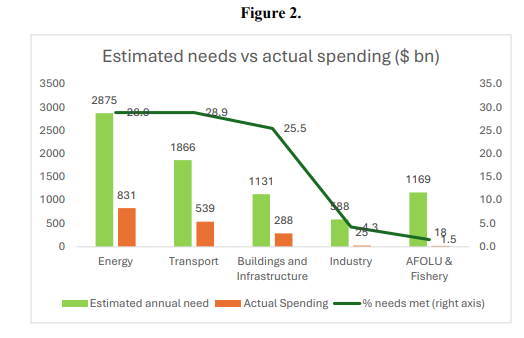
Of course, this is still well below the actual global needs, as indicated in Figure 2. The largest part of mitigation finance was for energy, at $831 billion, but even that provided less than 30 per cent of the estimated requirement. Meanwhile, while AFOLU (Agriculture, forestry and other land use) and fishery are estimated to require more than $1 trillion of spending annually, the actual spending was only 1 per cent of that in 2023.
What makes matters much worse is that such spending is largely concentrated in the advanced countries and China. 79 per cent of all climate finance was concentrated in just three regions: East Asia and the Pacific (largely China), Western Europe and the US and Canada.
In the developing world (excluding China), the pattern was reversed, with most climate mitigation finance (78 per cent) coming from public rather than private sources. In 2023 it was
estimated at $196 billion, which represents a nearly threefold increase from 2018. Most of this (nearly 80 per cent) was from national sources, with only $42 billion coming from cross-border flows of finance. Once again even this relatively small amount was regionally concentrated, with the bulk going to Latin America and the Caribbean, the Middle East and North Africa, and Central Asia and Eastern Europe, largely in the form of clean technology investment.
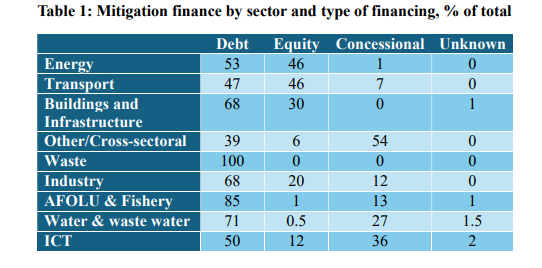
Another concern relates to the type of financing. Table 1 provides a sense of the relative importance of debt, equity and concessional financing by mitigation sector. It is striking to see that
concessional finance is effectively non-existent for energy, buildings and infrastructure and waste management, and provides a relatively small proportion of finance for transport, industry and AFOLU (agriculture, forestry and other land use) and fishery. Instead, debt flows dominate in most sectors.
This huge reliance on debt for climate finance may appear to be positive because it enlarges the potential pool of investible resources. Indeed, it was the presumption of the “billions to trillions” slogan at one time beloved of the multilateral financial institutions. But the accrual of debt, especially for investments that do not generate the monetary returns expected by financial markets, comes with its own problems, which are now too well-known to require further elaboration here. These problems are particularly important for lower and middle income countries that have experienced debt stress in the past decade. In a way it is ironic that the same multilateral institutions that have been unable to address the massive debt repayment problems faced by many such countries are also advocating for more debt to be taken on by these very countries for purposes of climate change alleviation.
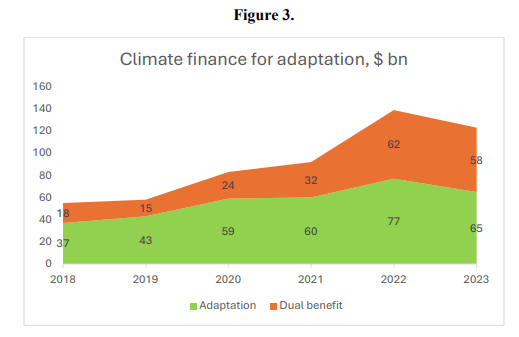
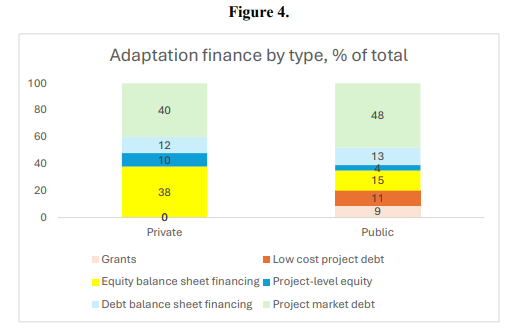
Similar trends are evident in adaptation finance. Since it is more difficult to make a commercial case for many aspects of climate change adaptation, there has been growing reliance on “dual benefit” financing, which cover both mitigation and adaptation needs. This is shown in Figure 3. This is when adaptation finance effectively overlaps with development finance, on the grounds that investments aimed at reducing communities’ economic or social vulnerability often also enhance resilience to climate change, in addition to other benefits. (For example, road or building construction that is undertaken with deliberate consideration of climate impacts and the needs of vulnerable people in mind, to provide greater resilience in periods of climate stress.)
Nonetheless, much adaptation is necessarily not commercially profitable. This is why the significant reliance of not only private finance, but debt-based finance by both public and private
sources, can become a problem. Clearly, a much greater emphasis on public provision and therefore public finance is essential if the needs of climate alleviation are to be met more effectively.
( This article was originally published in the Business Line on 3 March 2026)