
Who Says Economic Growth Generates Employment?
The idea that economic growth leads to more employment is at one level so obvious that it has become axiomatic among economists and policy makers. After all, higher production will require more inputs, and presumably labour is a crucial input for many, if not most, activities. Therefore, it is common to find that both policy makers and analysts routinely make the promotion of GDP growth their central focus, relying on the perception that this will inevitably generate more employment.
Of course, higher labour productivity (output per worker) is also typically a policy goal. So it is also assumed that within sectors and activities, per unit labour requirements may (and should) decrease, but overall economic expansion will ensure that until full employment or full capacity utilization is achieved aggregate output increases will generate additional employment.
It is recognised that the response of job creation to output growth (or the employment elasticity of output growth) will vary, especially with more labour-saving technological change. Estimates of the employment elasticity of output growth, and how that changes over time, are therefore important. Even so, it is generally accepted that even if such elasticities are low or declining, they will always be positive.
The ILO’s World Economic and Social Outlook Update for May 2025 provides some data for us to assess how this relationship between output and employment has played out in the decade 2014- 2024. Figure 1 shows how the aggregate relationship has changed for the world as a whole and across the major regions. Figure 2 shows the employment elasticities of output growth based on these indicators.
While the relationship between aggregate GDP growth and total employment (covering also selfemployment, informal employment, part-time employment, etc.) was positive, two features stand out. The first is the quite stark difference in growth rates of GDP and of employment for the world as a whole, explained by labour productivity growth which seems to have been very rapid over this period. But the second and possibly more startling feature is the significant variation across regions, not only in aggregate changes but in employment elasticities.
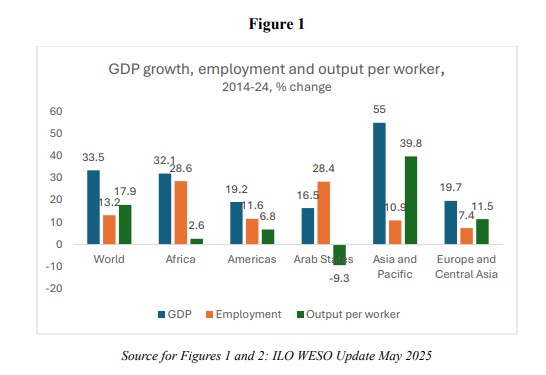
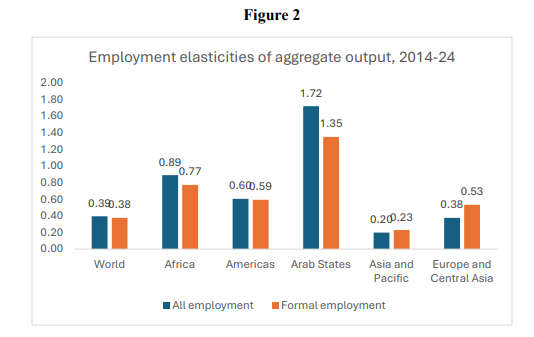
Thus, the Arab States and the Asia and Pacific region are outliers in opposite directions. In the Arab States, GDP grew more slowly than employment, resulting in employment elasticities significantly greater than one and negative changes in labour productivity. In the Asia and Pacific region, GDP increased very substantially, mostly associated with significant increases in labour productivity, such that the employment elasticity of output was extremely low. In Africa, employment elasticities were also high, close to unity. In the Americas and in Europe and Central Asia, growth of all the aggregate variables was relatively low, and employment elasticities were moderate.
Of course, it could be argued that such broad regional groupings are too large and contain very diverse economies and therefore do not provide sufficient understanding of actual economic
processes within the regions. In addition, lumping together aggregate changes over a decade can obscure short-term relationships and that between output and employment obviously must operate over the short term.
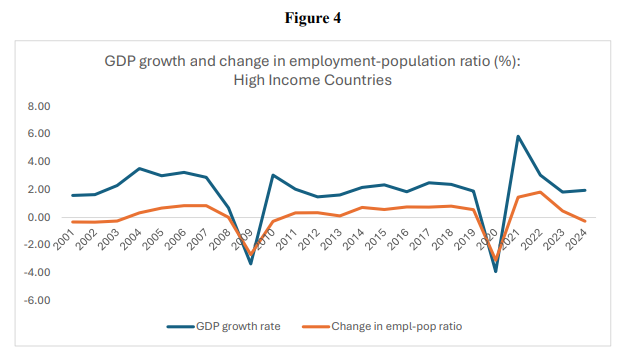
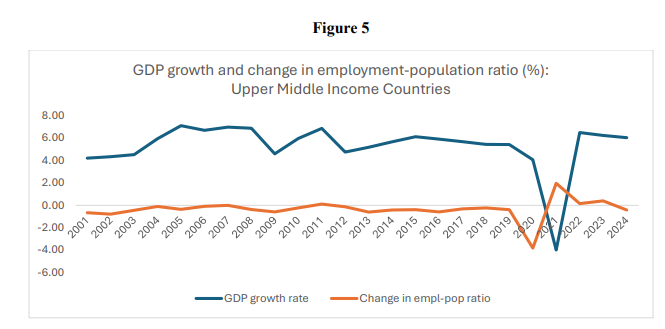
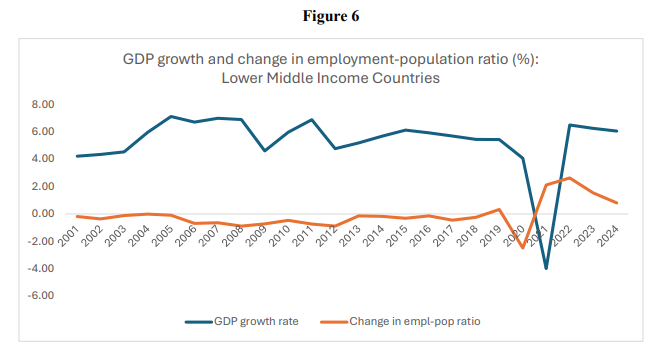
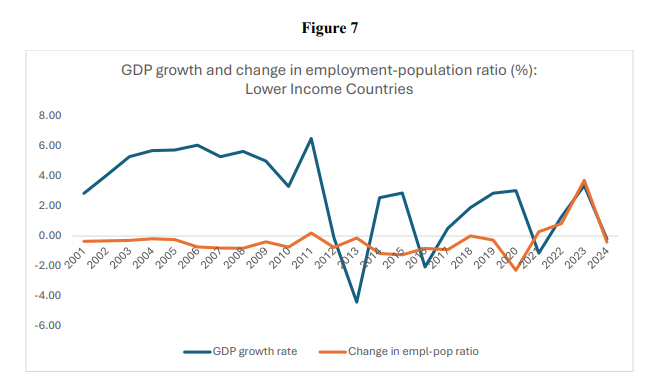
Another approach could be to examine the changes in GDP and in the active worker population ratio in each year, to see if there is any evidence of clear positive relationship. Since the population estimates tend to be relatively stable over time, estimates of the worker population ratio (employed workers to population age 15+ years) can provide a proxy for short-run employment changes. These trends are shown for the world economy as a whole and for groups of countries based on levels of per capita income, in Figures 3 to 7, using data from the World Bank’s World Development Indicators.
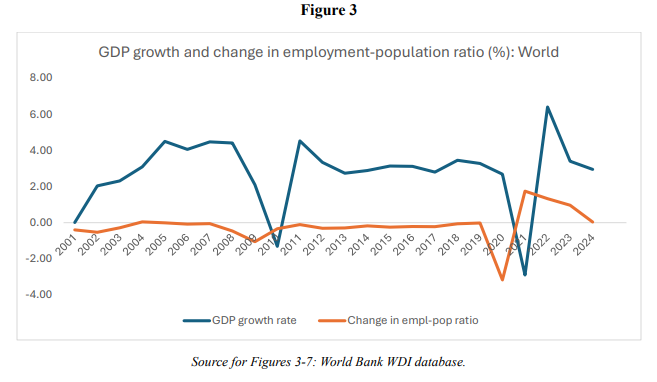
Figure 3 shows the trends for the world as a whole since 2000, and it suggests a very different relationship almost a non-relationship between GDP growth and employment. It is true that GDP growth has been volatile, with three episodes of crisis (in 2001, 2010 and 2021) when GDP was stagnant or declined. But the employment-population ratio barely budged over most of this period and in fact seems to have declined slightly in most of the years of this quarter century. Certainly, there is little evidence of a short-term positive relationship with GDP growth. The lags, where they are evident, also do not appear to have much economic rationale.
The picture changes slightly according to income groups. The high-income countries (HICs) shown in Figure 4 do indeed show a positive relationship, with changes in employment to population ratios closely tracking GDP growth. The changes in the employment-GDP ratio are much lower than those in GDP, but they are generally in the same direction. Therefore, in high income countries, employment appears to follow the business cycle, as expected.
But the same cannot be said for the other country groupings. Indeed, the lack of correlation between the two variables that can be observed for the world as a whole is really because of these
other country groupings.
Figures 5 and 6 show that in both upper and lower middle-income countries, employmentpopulation ratios have been mostly stagnant (with the exception of the pandemic year 2020 which
showed a significant decline and then a recovery in the following year). But even more notably, the changes in the ratio have been negative throughout this period, barring a few most recent years.
What is clear is that the more rapid GDP growth in these middle-income countries (which as a group have the highest GDP growth rates) did not lead to increases in the employment -population ratio either in that year or the following year, or through the period as a whole. In other words, the employment-population ratio has not only been inelastic with respect to income growth but has in many years been negatively correlated.
The lower income countries described in Figure 7 point to an even more disturbing trajectory, one in which employment-population ratios fell over almost the entire period, until 2022. Such a pattern definitely calls into question any positive relationship between output and employment in most countries in the world. Clearly, the factors determining employment generation are more complex and deserve to be analysed carefully to put in place the appropriate strategies.
But first, governments and those who advise them have to stop assuming the GDP increases will be enough to create more jobs.
( This article was originally published in the Business Line on 8 January 2026. )